WhatsApp introduces a new AI Writing Help tool, providing users with secure, private suggestions to improve the clarity, tone, or style of their messages. The tool leverages Private Processing to generate multiple tone options while keeping all message data completely confidential.
| Key Points | Details |
|---|---|
| Name of the feature: | Private Writing Help |
| Status: | Rolling out |
| Compatibility: | The latest versions of WhatsApp for Android and iOS are designated as compatible updates. |
| Availability info: | This feature is available to some users, and it is rolling out to more users over the coming weeks. |
| Previous news: | WhatsApp beta for Android 2.25.24.15: what's new? WhatsApp is rolling out a feature that allows users to encrypt their backups using a passkey! |
PRIVATE WRITING HELP
In the article about the WhatsApp beta for Android 2.25.23.7 update, we announced that a Writing Help feature powered by AI Private Processing was available. Through Private Processing, requests are transmitted securely and anonymously, so they cannot be linked back to a user's identity. The system generates multiple AI-powered suggestions without retaining any message content, guaranteeing that communication remains private. As a result, users can benefit from enhanced writing support while maintaining full control over their messages and data. Initially, Writing Help was made available only to a small number of users. This limited rollout probably allowed WhatsApp to quietly test the feature, collect bug reports, and gather valuable feedback ahead of a broader launch. Today, more users can access Writing Help to refine their messages with greater ease and flexibility, taking advantage of AI-powered suggestions while keeping their conversations private and secure.
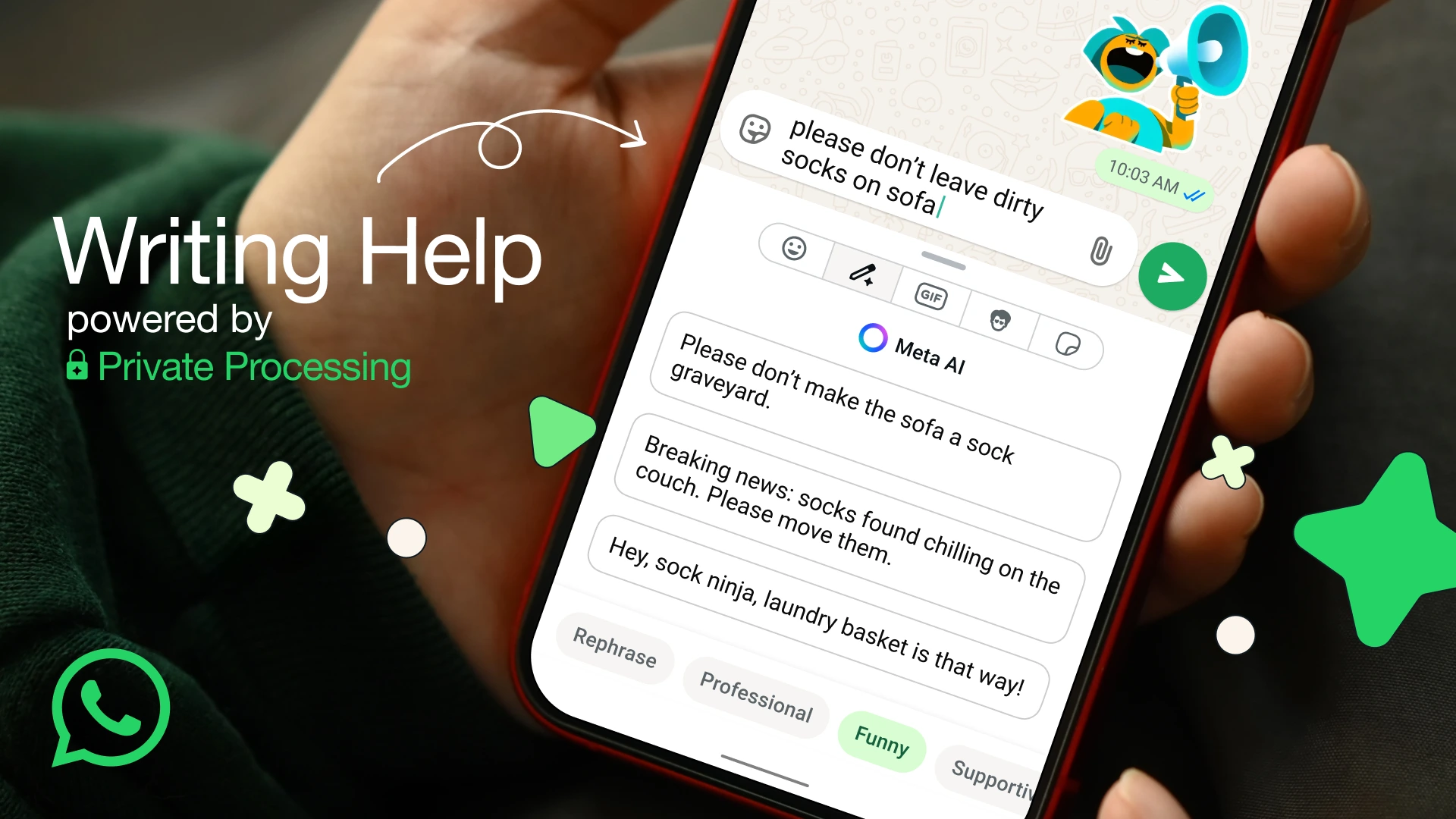
WhatsApp announced in a dedicated blog post that Writing Help is a new AI-powered assistant designed to make everyday messaging clearer, more professional, or simply more fun. Writing Help allows users to quickly improve the tone and clarity of their messages by providing tailored suggestions that they can choose from. Users can turn to Writing Help whenever they want to sound more polished in a professional chat, add a touch of humor to a casual message, or simply make their writing clearer. It can also be helpful when offering comfort, writing more empathetic responses, or ensuring a message is free from grammar and spelling mistakes.
Writing Help relies entirely on Private Processing, a secure technology developed by Meta to ensure that all user data remains safe and anonymous. Private Processing works by encrypting requests and using anonymous routing so that no message can be linked to the identity of the user who sends it. This means that messages processed through Writing Help are never stored on Meta' servers, nor are they visible to either WhatsApp or Meta. Every request is handled privately, leaving no digital trace behind. As a result, no one, not even Meta or WhatsApp, can read the content of the messages or the AI-generated suggestions.
Since Writing Help depends on Private Processing, users must first enable this feature in the app settings before they can access the assistant. Once activated, Writing Help becomes available in the message field whenever the user starts typing. Writing Help cannot see what users are typing until they decide to tap the pencil button and explicitly request suggestions for their drafted message. By tapping this button, users can select one of the available tones and request Private Processing to provide improved versions of their message. The tones currently include rephrase, professional, funny, supportive, and proofread, with the potential for WhatsApp to expand this list in the future by adding new styles or refining existing ones to better match different user needs.
After receiving suggestions from Private Processing, users can freely decide whether to keep their original text or replace it with one of the improved options. It's important to note that the recipient of the message will not know that Writing Help was used, since suggestions are seamlessly integrated into the normal messaging flow. This ensures that users retain full control over their communication while enjoying the benefits of AI-powered writing assistance.
WhatsApp collaborated with leading experts in the security community to rigorously test and validate the architecture of Private Processing, ensuring its resilience and trustworthiness. This continuous effort has allowed WhatsApp to further strengthen the technology and uphold the highest standards of privacy protection. Today, independent researchers at NCC Group and Trail of Bits also released their analyses, confirming the progress WhatsApp has made in evolving this privacy-preserving system. Their audits finally highlight the robustness of the approach and provide valuable insights that will guide future enhancements.
Since Writing Help is completely optional, only users who deliberately enable Private Processing will have access to this feature. At any moment, they can also choose to turn it off again in the app settings, ensuring they never use it unless they want to. This puts users in complete control of their messaging experience and of which AI features they prefer to activate. Additionally, Writing Help will never interfere automatically with conversations, and that the final decision to use AI suggestions always rests with the user.
WhatsApp confirmed that Writing Help is gradually rolling out in English on both iOS and Android, starting with the United States and several other countries. WhatsApp plans to expand availability to more languages and regions later this year.
Following WABetaInfo on X is the best way to stay informed about new features under development and those released to WhatsApp beta for Android, iOS, Web, and Desktop. We love hearing your feedback, so let us know what you think! You can also explore our dedicated page to discover all our services, or join our Discord Server to chat with others, get help and advice, and stay up to date with the latest WABetaInfo announcements.