WhatsApp is rolling out a new privacy feature that allows users to control how their contacts are synced across multiple devices. This includes an option to keep contacts stored within WhatsApp or sync them with their phone's address book, making it easier for users to manage their contacts.
| Common questions | Answers |
|---|---|
| Name of the feature? | WhatsApp contacts |
| Status? | Rolling out |
| Compatibility? | The latest updates of WhatsApp for iOS and Android are marked as compatible updates. |
| I have the same version but I don't have this feature, why? | This feature is widely available. However, it might take a few days to fully roll out to all users. |
| Previous news? | WhatsApp beta for Android 2.24.22.11: what’s new? WhatsApp is working on a feature to share music through status updates! |
WHATSAPP CONTACTS
In the article about the WhatsApp beta for iOS 24.20.10.76 update, we announced that WhatsApp was rolling out a new privacy feature to manage the contact syncing option. This feature grants users greater control over how their contacts are synchronized across multiple devices, providing the ability to disable syncing for specific accounts. Users can now decide whether they want to sync their contacts with their phone's address book or keep them stored exclusively within WhatsApp, making it more convenient to manage contacts independently. Previously limited to beta testing, it appears that the contact syncing option can now be accessed by everyone, as WhatsApp has officially announced in a new blog post that this feature is widely available to all users.
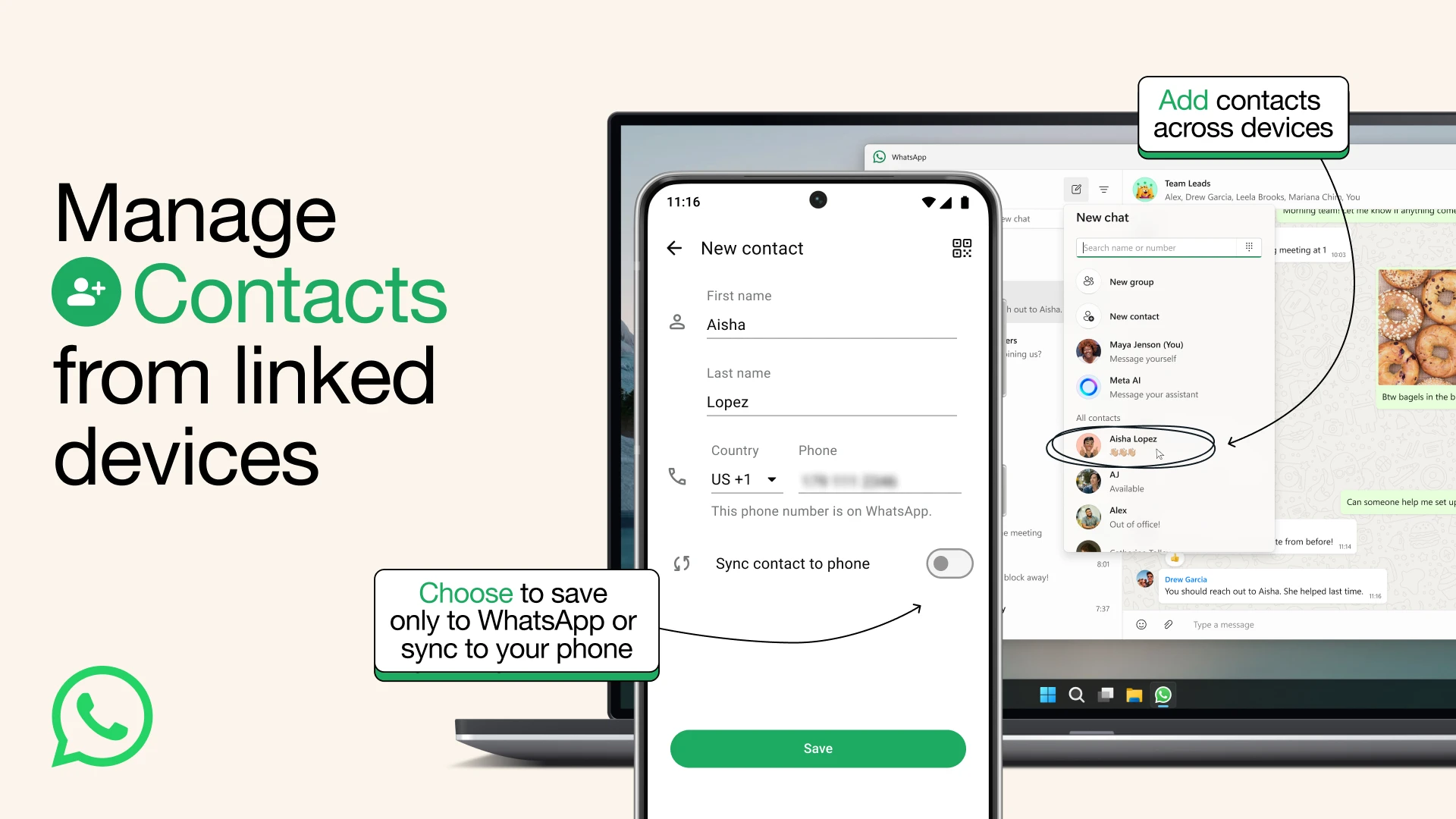
Through the option available within WhatsApp Settings > Privacy > Contacts > WhatsApp Contacts, users can fine-tune their contact synchronization preferences, giving them more granular control over how and where their contacts are stored. Users can now decide whether to sync their WhatsApp contacts with their phone's address book or keep them stored within WhatsApp, depending on their own preferences. This feature also allows users to add and edit their contacts across their linked devices, ensuring that any changes made on one device are seamlessly reflected on others.
One of the most useful aspects of this update is a new toggle labeled "Sync contact to phone" that appears when users add a new contact. This toggle lets users decide on a contact-by-contact basis whether they want to sync a particular contact to their phone's address book or keep it stored only in WhatsApp. This means users can maintain certain contacts exclusively within WhatsApp, ensuring that they don't appear in the phone's general contact list. For those who use WhatsApp on multiple devices, this feature makes it easier to manage contacts across all linked devices without having to rely on their phone's address book.
With this feature, WhatsApp has also introduced a new storage system called Identity Proof Linked Storage (IPLS), which securely stores contact information and allows users to restore their contacts even if they lose their phone. This system implements Key Transparency, ensuring that users can verify the authenticity of their contacts and track any changes made to their identity keys. To enhance security further, WhatsApp has partnered with Cloudflare, which provides independent verification to ensure that contact data is not tampered with. This partnership also allows WhatsApp to audit key transparency for end-to-end encrypted messages, ensuring that the public keys used for encryption remain unaltered and uncompromised during transmission.
It is important to mention that WhatsApp further enhances privacy by using cryptographic hashes to protect the phone numbers of contacts who do not have a WhatsApp account. This means that even when contact syncing is enabled, WhatsApp does not store or share these details on its servers in a way that might compromise privacy. Instead, cryptographic hashes are created for these phone numbers, ensuring that user data is always secure. These hashes act as digital representations of the phone numbers, which WhatsApp can use to detect unusual activities or potential misuse of the contact upload feature, such as attempts to identify who uses WhatsApp, without actually storing or tracking individual contact information.
It is worth noting that WhatsApp contacts will also be automatically restored when users reinstall the app, change phones, or link a new device, ensuring enhanced access to their contact list. This happens even if contacts are not synced with the phone's address book, making it convenient for users who frequently switch devices. If you're interested in a deeper dive into how WhatsApp preserves storage for your WhatsApp contacts, we recommend exploring their detailed engineering blog to gain insights into the technical innovations behind Identity Proof Linked Storage.
A contact syncing feature is available to users who install the latest updates of WhatsApp for Android from the Google Play Store and WhatsApp for iOS from the App Store, and it is rolling out to even more people over the coming days.
Stay up-to-date on WhatsApp news by following WABetaInfo on X. You can also discover other new features for WhatsApp beta for Android, iOS, Web/Desktop, and Windows.
Do you like this news? Please, let us know on Twitter: we love hearing your feedback! If you're curious to know where you can find WABetaInfo, there is a dedicated page where you can discover our services.
In addition, we have set up a Discord Server where you can chat with other people, get help and advice, and stay up to date with the latest announcements from WABetaInfo.