Meta enhances WhatsApp with new upcoming AI feature updates powered by Secure Private Processing
Meta developed Private Processing, a secure technology that will enable AI-powered features like message summarization and writing suggestions while fully preserving user privacy. This ensures that no one, including Meta or WhatsApp, can access users' private requests, including messages.
| Common questions | Answers |
|---|---|
| Name of the feature? | Private Processing |
| Status? | Under development |
| Availability? | WhatsApp is currently working on bringing new AI features powered by Secure Private Processing to a future update of the app. |
| I have updated my version of WhatsApp but I don't have this feature. Why? | Private Processing is a feature under development that will be available in a future update. |
| Previous news? | WhatsApp beta for Android 2.25.14.7: what's new? WhatsApp is rolling out a feature to choose how voice messages are transcribed! |
PRIVATE PROCESSING
AI has transformed how users interact with technology, allowing them to automate tasks and extract insights from large data sets. However, the way current AI systems across industry process information often requires sending data to servers, which can raise questions about privacy. To address this, Meta has developed a solution that enables future AI-powered features, such as message summarization and writing suggestions, all while ensuring user privacy is fully maintained. This new technology, called Private Processing, will allow users to explore advanced AI capabilities while keeping their messages secure and private, maintaining the level of privacy people expect from WhatsApp. This ensures that no one, except users and the people they're communicating with, can access or share personal messages when using AI features powered by Private Processing, not even Meta or WhatsApp.
The architecture of Private Processing is designed to enable AI to process private data while ensuring that no one, including Meta or WhatsApp, can access it. Private Processing builds a secure cloud setup where AI can work on user data without exposing it to any unauthorized parties. It is built in a way that nobody, including Meta or WhatsApp, can break into that vault during processing. To make this possible, the system verifies that the requests come from legitimate WhatsApp users' clients, protects their identities through secure private routing, and establishes encrypted connections to a secure environment. Once the connection is established, the user's device sends requests, like asking for message summaries, which the AI processes securely without retaining any of the original data. Finally, the result is securely sent back to the user's device, without retaining any of the original data. WhatsApp plans to give users complete control over private processing, allowing them to enable the feature through the app settings in the future, along with access to logs of their requests.
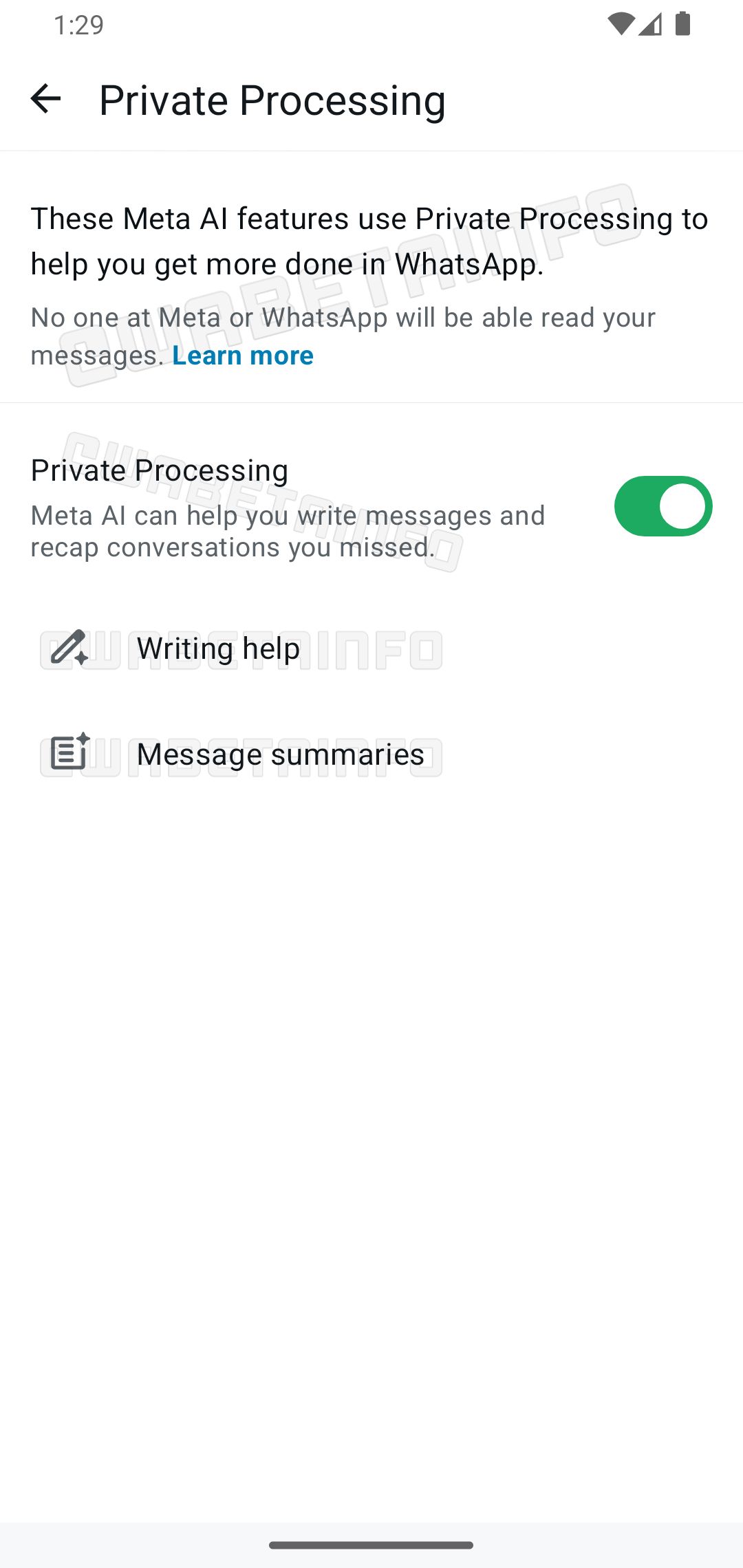
To further build trust and ensure transparency around Private Processing, Meta designed Private Processing with several important ideas in mind. First, using AI features that rely on Private Processing is entirely optional, as users can decide for themselves whether they want to take advantage of these tools. Whenever Private Processing is involved in a feature, WhatsApp must clearly communicate that to users, leaving no room for hidden processes. For those especially sensitive conversations, people have even greater control through the Advanced Chat Privacy setting, that can prevent users from interacting with AI features in these particular chats.
Beyond these choices, Private Processing is built to protect data in deeper and technical ways. When information is sent for processing, it remains entirely confidential, as not even Meta or WhatsApp can see it while in transit, during, or after it is handled. If anyone attempts to interfere with the system's secure environment, the design ensures that such tampering either forces the system to shut down or becomes publicly discoverable by researchers. In addition, since the digital world is constantly facing new threats, Meta added even more protections. An attacker cannot simply target a specific person, as they would need to compromise the entire Private Processing system, making targeted attacks extremely difficult. Also, once a request is processed, the system does not retain access to the original messages, ensuring that even if someone were to break in later, there would be no stored past conversations to steal.
Meta explained that protecting user messages and secure processing machines is central to building a system like Private Processing. To defend against hackers, insiders, and even malicious users, the system limits its exposed parts, verifies software integrity, and strengthens defenses against physical attacks. It also hides user connections through third-party relays, making it extremely hard for anyone to target a specific person. Additionally, Private Processing uses the OHTTP protocol to create secure sessions that prevent Meta and WhatsApp from knowing which user is connecting to which secure server. This setup makes it impossible for a user's request to be linked to specific hardware, keeping identities hidden during the process. These also involve anonymous credentials, which allow the system to confirm that a user's client is legitimate without revealing who they are, and no personal information is attached to the session setup. To add an extra layer of trust, users will also be able to view a log inside the app showing what information was shared and how the secure session was created.
Meta plans to publish the source code for important parts of Private Processing, like the attestation verification and other components of the system code, to support deeper security research. Meta is also expanding their Bug Bounty program to specifically include Private Processing, encouraging independent researchers to look for vulnerabilities. In addition, Meta will release a detailed technical white paper explaining the security design behind Private Processing. All of these efforts aim to increase transparency and help others in the industry build similar secure solutions, while providing users on WhatsApp with a solution that ensures their privacy is fully protected when using AI features that rely on Private Processing. In the meantime, if you're interested in a deeper dive into how WhatsApp protects user privacy while enabling AI features, we recommend exploring their detailed security engineering blog to gain insights into Private Processing and how it securely handles sensitive data.
The private processing feature is under development and it will be available in a future update. We will keep you updated with an additional article as soon as we have more details to share about this feature.
Stay up-to-date on WhatsApp news by following WABetaInfo on X. You can also discover other new features for WhatsApp beta for Android, iOS, Web/Desktop, and Windows.
Do you like this news? Please, let us know on X: we love hearing your feedback! If you're curious to see where you can find WABetaInfo, there is a dedicated page where you can discover our services.
In addition, we have set up a Discord Server where you can chat with other people, get help and advice, and stay up to date with the latest announcements from WABetaInfo.